

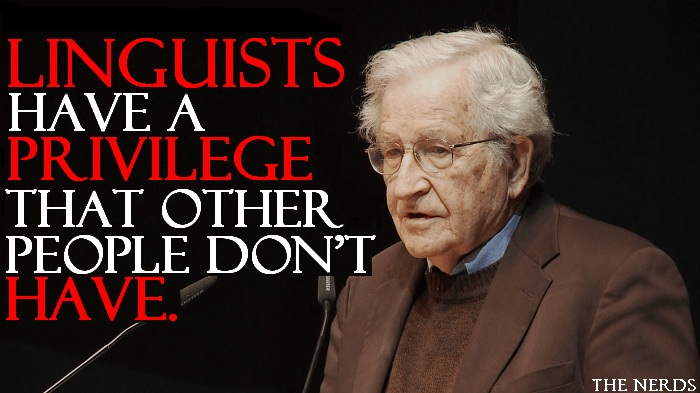
Studying languages is a privilege. When you analyze language and everyday speech you start to realize that there is an astonishing amount of wonder in this system that we take for granted. Linguists questioned the obvious, which is language, and got answers that forever changed mankind’s understanding of Language and human nature. In this article, you will see what linguists know that is not so evident to other people. So let’s see what we’ve got.
- We all speak one language.
One of the main discoveries of modern linguistics is that it made us aware that all the languages we speak are similar in astonishing respects; they manifest the same pattern, follow the same rules, they are learnt in exactly the same way, and that all the differences are only superficial. So, in a sense we all speak the same language. This was captured by Chomsky in an excellent metaphor in an excellent book of his titled Language and Mind in which he says that if a Martian scientist, somebody with a different kind of intelligence, were to study the world’s languages, he would conclude that they are all dialects of a single language embodying a «universal grammar» reflecting a hardwired, genetically determined linguistic module inherent in the human brain. A great deal of theories complied a huge base of evidence from topologically different languages to show that this is indeed the case. I will mention, in passing, one of probably the main arguments used to prove this. Take a child that was born in China, and have him raised in Saudi Arabia and he’ll grow up speaking Arabic. What does that say to you? It says that a human child is hardwired to learn any language and that all human languages, say Mandarin and Arabic in this case are fundamentally the same, if they weren’t, the task of child to learn any language would be impossible. This has massive implications, the greatest of which is that all the 7000 human languages have the same source and that every language spoken today evolved from the same great-great…great-grandmother tongue, the first language of homo sapiens. Another implication is that if a Martian would fly past our planet, he would hear Japanese and Ojibwe like we hear British and American English. This is an interesting line of thought, If you want to read more about it, I got a good book you could read. It’s called Chomsky’s Universal Grammar: An Introduction. Find it [here].
- Language change is natural:
Too many people fear language change. Many people think that if we don’t attempt to regulate the «correct» way of speaking — from spelling to pronunciation to word choice — then we will all plunge into anarchy or some other misfortune. It’s a sham. Language constantly evolves, and even those political/cultural elites who claim to use it «correctly» fail to do so themselves; this is why you find split infinitives in written opinions of the U.S. Supreme Court, for example. (And even those who fancy themselves guardians of The Correct Way of Speaking can’t even agree on whether split infinitives are kosher). Societies rise and fall, but not because too many people started to say «ain’t» when they should have said «isn’t.»
- There are no bad grammars:
- There are monolingual linguists:
- Language is fractal:
- Fucking insertion is systematic:
linguists know that the process of infixing fucking to emphasize a word is systematic. Fucking always goes before the primary stressed syllable in a word. Anything else sounds wrong:
fan-fucking-tàstic, not fantà-fucking-stic
abso-fucking-lùtely, not ab-fucking-solùtely
hippo-fucking-pòtamus, not hi-fucking-ppopòtamus or hippopò-fucking-tomus.
Phila-fuckin-delphia and anything else is wrong.
- Monoglots can become polyglots:
Linguists know that everybody who speaks one language, can learn others, if they want to. The mathematics behind linguistics (e.g. Automata Theory and Chomsky’s hierarchy of languages), indicate that an astonishing amount of intelligence is required to become a monoglot. The more we study computational linguistics and automata theory, the more we understand this.
The simplest theoretical machine that could accurately parse a human language and map to meanings, would be incredibly complex. Surprisingly, the amount of complexity one must add in order to parse a second language is almost negligible. In other words, there is no real difference in the intelligence necessary to become a monoglot or a polyglot.
Perceived differences in difficulty have more to do with learning as an adult vs. as a child (during the critical period), and with enjoyment of learning and willingness to work.
I’m sure linguists know so much more than can be said in a blog post. Linguists changed our perceptions about language, changed the way we regard minority languages, and most importantly linguists made us aware that no language is inferior. Join the bandwagon to recognize the efforts of linguists by subscribing by email and sharing the article. Thank you very much for reading. I will see you in my next article.
 Anuario de Glotopolítica
0 comments on “What linguists know that other people don’t.”